In 2013, Eugene Fama and Kenneth French won the Nobel Prize in Economic Sciences. They revised the Capital Asset Pricing Model (CAPM), which simplified the estimation of how much return is required to justify an investment.
The CAPM calculates the expected return by comparing how much investors can expect to earn from investing in the market, such as the S&P 500, with the return on short-term government bonds. This difference, known as the market premium, is then multiplied by beta, which measures how a specific investment moves in relation to the overall market, to derive the expected return. William Sharpe, along with John Lintner and Jan Mossin, developed the CAPM based on Harry Markowitz’s portfolio theory. Sharpe later received the 1990 Nobel Prize in Economic Sciences, shared with Markowitz and Merton Miller, for their foundational work on risk and return.
Fama-French Three-Factor Model
Fama and French later revised the CAPM and introduced two additional factors in their Three-Factor Model, where market risk, the first factor, comes from the original CAPM. The model incorporates two further dimensions to calculate the required rate of return: the effect of company size, and the company’s book value relative to its stock price.
In their research, Fama and French found that smaller companies tended to have higher returns than larger ones. They incorporated this observation into the model as SMB (Small Minus Big). In this factor, the return of large companies is subtracted from that of small companies, which consistently showed positive values, indicating that returns for small companies were greater than those of large companies.
Another factor they added was HML (High Minus Low). In this factor, they subtracted the returns of low book-to-market companies from those of high book-to-market companies and found that firms with higher book-to-market ratios tended to have higher rates of return than those with lower ratios.
To understand the book-to-market ratio, it is first necessary to know what book value means. Book value is an accounting value that would theoretically remain for investors if the company were to close for business. Upon liquidation, the company could sell its land, buildings, equipment, and other assets, and the proceeds from these sales would be returned to investors.
Although such a scenario is highly unlikely for companies listed in major indexes such as the S&P 500 and Russell 2000, investors may still use it to compare against the company’s stock price, which makes the book value meaningful.
For example, the book value for Citi at the end of 2024 was $101.62 per share. Divided by its stock price of $63, the book-to-market ratio is 1.61. This is considered a bargain because the book value per share is 1.61 times the stock price, indicating that the company’s net assets, as reflected in its accounting value, exceed the market’s valuation of the stock.
On the other hand, Wells Fargo’s 2024 book value was $46.20 per share. Divided by its stock price of $54, the book-to-market ratio was 0.86. This figure suggests that the stock is priced at a premium, as the market’s valuation surpasses the book value. This implies that investors anticipate the company’s future growth potential beyond its current net asset value, thereby categorizing it as a growth stock.
| Company | Book/Share | Stock Price | Book/Market | Category |
| Citi | $101.62 | $63 | 1.61 | Value |
| Wells Fargo | $46.20 | $54 | 0.86 | Growth |
Long-Term Trends in SMB and HML
Fama and French’s three-factor model, which adds SMB and HML in addition to the general market premium in CAPM, enables investors to make decisions that are more rigorously determined than the original CAPM.
In Fama and French’s study that spanned from 1941 to 1990, they found consistent premiums in SMB and HML. However, they also pointed out that these results may have been due to the specific time period they selected, suggesting that the trend could change in the future.
In fact, the trend has shifted in recent years. A decade is enough time to form a trend, and a sound strategy may make a significant difference in one’s asset accumulation.
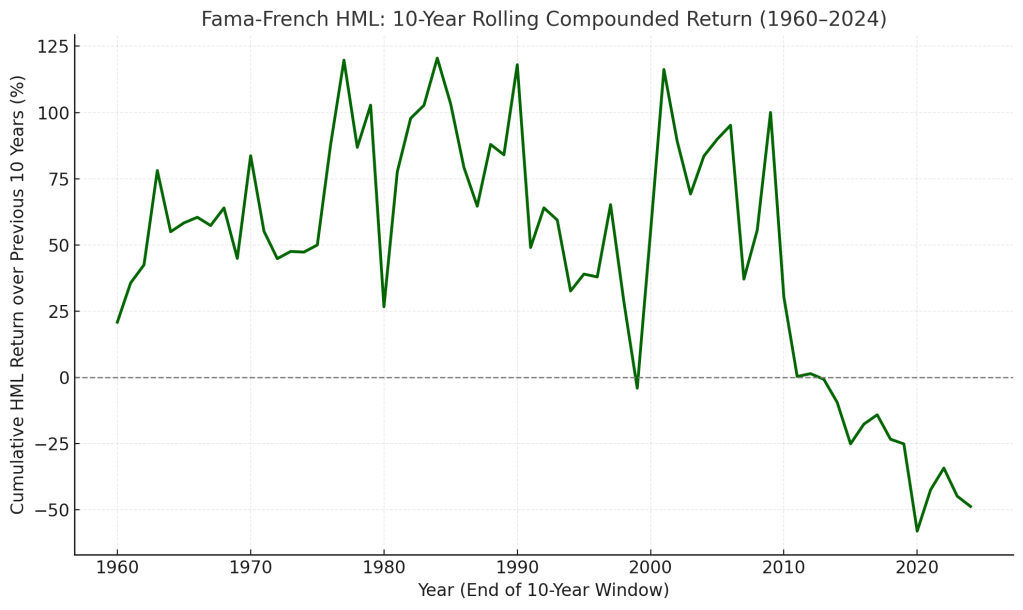
The graph shows the SMB premium in cumulative rolling 10-year periods from 1960 to 2024. For example, the 1960 data represents the cumulative return of SMB from 1951 to 1960, while the 2024 data point shows the return from 2015 to 2024.
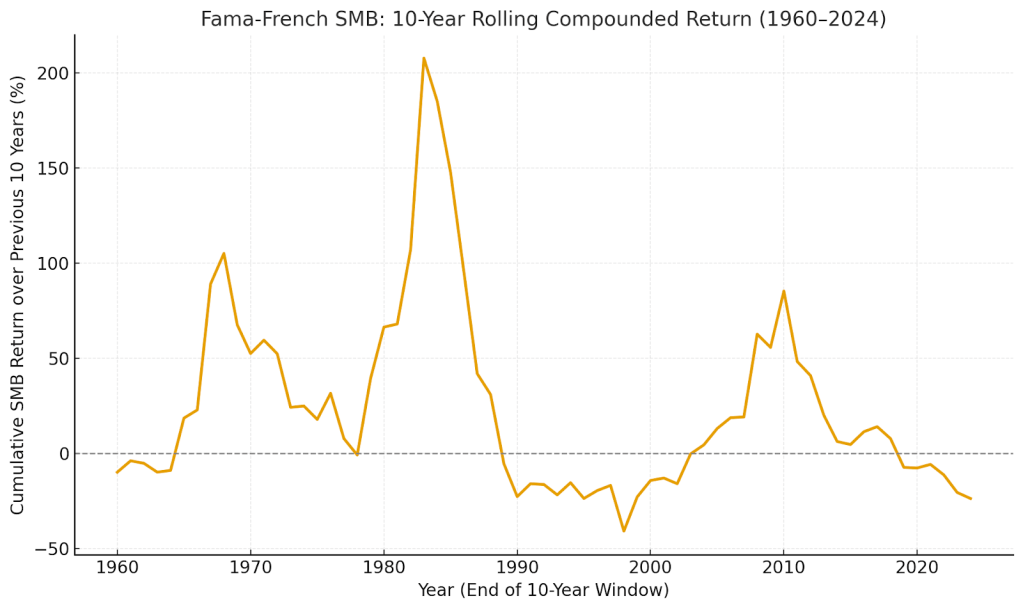
As Fama and French’s study found, SMB showed almost consistent premiums until 1990. In the mid-1980s, a portfolio with small-cap stocks performed over 200% better than large-cap ones.
However, this trend reversed in the rolling 10-year period of the 1990s, when large-cap stocks outperformed small caps. Small caps began to outperform large caps again in the mid-2000s until the late 2010s.
The trend reversed again in favor of small stocks from the rolling 10-year period of the late 2010s to the present. Since it is a 10-year rolling period, the 2019 data point represents cumulative returns since 2010, indicating that large-cap outperformance has persisted for nearly 15 years.
While size effects have shown cyclical patterns over time, the value factor has followed a somewhat similar trajectory. As Fama and French’s research shows, the trend for the value stock premium, reflected in HML, was strong during the rolling 10-year periods between 1960 and 2010. The only negative period occurred between 1990 and 1999, which coincided with the dot-com bubble, when speculation on internet stocks skyrocketed. The trend returned to normal after the crash but began to reverse again in the rolling 10-year period starting in 2010.
This reversal in the value factor has persisted. The HML has been negative since the rolling 10-year period beginning in 2014, largely due to the dominance of technology companies. They do not have as many durable assets such as land, capital, and equipment compared to sectors like manufacturing and finance. Instead, they hold assets that are less easily sold, such as intellectual property and licenses. This asset composition means their book value is relatively low, which is reflected in the negative HML since 2014.
Market Concentration Risk
What is alarming is that in the S&P 500, nine out of the top ten companies are technology firms. Furthermore, these companies have a disproportionate share of the index’s total return, accounting for nearly 70% of it as of writing in late October, 2025.
| Rank/Company | Industry Type |
| 1. Nvidia | Technology/AI Hardware |
| 2. Apple Inc. | Technology/Electronics |
| 3. Microsoft | Technology/Software/Cloud |
| 4. Amazon | Technology/E-Commerse/Cloud |
| 5. Broadcom | Technology/Semiconductors |
| 6. Alphabet Inc. (Class A) | Technology/Advertising |
| 7. Meta Platforms | Technology/Social Media |
| 8. Alphabet Inc. (Class C) | Technology/Advertising |
| 9. Tesla, Inc. | Technology/EV |
| 10. Berkshire Hathaway | Diversified Holdings |
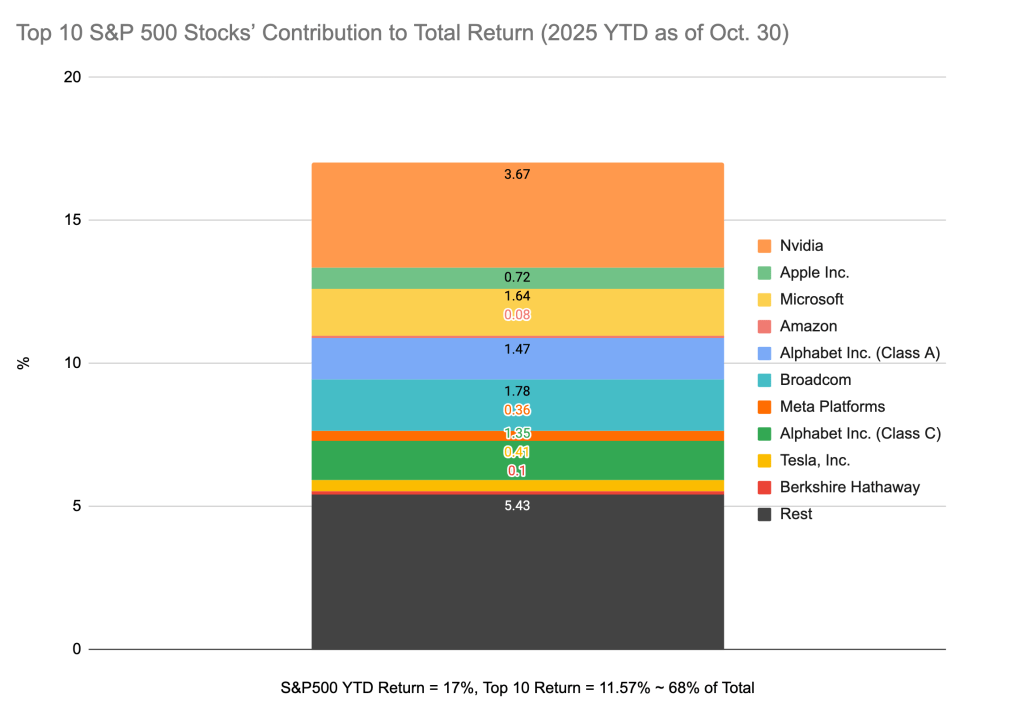
An interesting study by Goldman Sachs shows that the top ten stocks rarely stay there for ten years straight, likening this to how top-selling music artists rarely remain as popular a decade later. The study suggests that tech giants such as Nvidia, Google, and Microsoft may not remain in the top ten years from now. How they might fall out cannot be known, but it is possible that these technology stocks are significantly overvalued, especially given the uncertain commercial viability of AI products. In the event of a severe economic recession, they may be among the hardest hit, as technology company valuations have risen to seemingly dangerous levels.
Nvidia’s valuation has soared to $4.6 trillion in 2025, as its GPUs have become essential for machine learning and artificial intelligence. This figure exceeds the GDP of Japan and is nearly equal to that of Germany, both of which have diverse industries and abundant tangible assets.
In the case of Japan, the 2020 IMF Public Sector Balance Sheet (the latest data available due to the difficulty of compiling such data), a complex yet holistic financial dataset that reflects a country’s solvency, shows Japan’s net worth (or “book value”) to be over $48 trillion, by far the most solvent among the G7 nations. In contrast, while not an apples-to-apples comparison, but a cautionary one, Nvidia’s book value is only $100 billion.
The valuation of Nvidia has a resemblance with the bubble economy of Japan in the late 1980s – early 1990s, where a small piece of land, 1.31 square miles in Tokyo, before the burst of the bubble in 1987, was worth as much as the state of California. However, Japan’s urban land price fell by more than 80% after the bubble burst between 1991 – 2002.
If the top-performing technology stocks fall, their concentration in the overall large-cap growth return means that small-cap value stocks may see relatively better performance. While small-cap value stocks may fall alongside large caps, the current dominance of the large-cap growth sector could reverse.
Lessons from Cycles
While signs of a major market downturn are present, we may not know whether it will happen or when it will happen if it does.
Given the difficulty of predicting the future precisely, the importance of understanding subtlety cannot be overstated. Cycles exist not only in the broader stock market but also within factors like SMB and HML, but also in politics, which often align with economic cycles. To navigate these complexities, one must take in all this information, recognizing that there is no single answer or way to predict exactly what will happen. Such knowledge doesn’t guarantee outcomes, but it provides guidance for more thoughtful, resilient decision-making.
The information provided in this blog post is for educational purposes only and does not constitute financial advice. It is not intended as a recommendation to buy, sell, or hold any financial product, and I do not promote any organizations.
 The Well Tempered Investor