
Economists are often concerned with finding an optimal resource allocation where no one can be made better off or worse off, called Pareto-efficiency. Despite the ever-increasing government interventions in the economy since the Great Depression, the forces of the free market have largely determined this allocation in the US, including the prices and quantities of goods and services transacted.
However, allowing the free market to determine economic outcomes inevitably creates winners and losers, and critics have been proposing alternatives to this system. In the field of welfare economics, scholars like John Rawls argues for increasing the welfare of the disadvantaged. Rawls believes that increasing the welfare of the well-off individuals does not increase that of the worse-off individuals, thus society should be concerned only with helping the underprivileged. While it sounds righteous in theory, how feasible is it in practice?
California recently passed a bill requiring fast-food businesses in the state increase their minimum wage by $4.50, or by 30% from $15.50 to $20.00. It would be ideal for everyone who is currently paid minimum wage in this industry to benefit from the $4.50 raise, but the fact that there is a limited amount of money in the economy, especially when the Federal Reserve has been reducing money circulation by billions a month, means that wages cannot be increased without making trade-offs.
In light of this new wage hike, the popular fast-food franchise Pizza Hut has already announced that it would lay off more than 1,200 delivery drivers. This decision was made even before the law takes effect in April, 2024, and it suggests there will be more layoffs in the future.
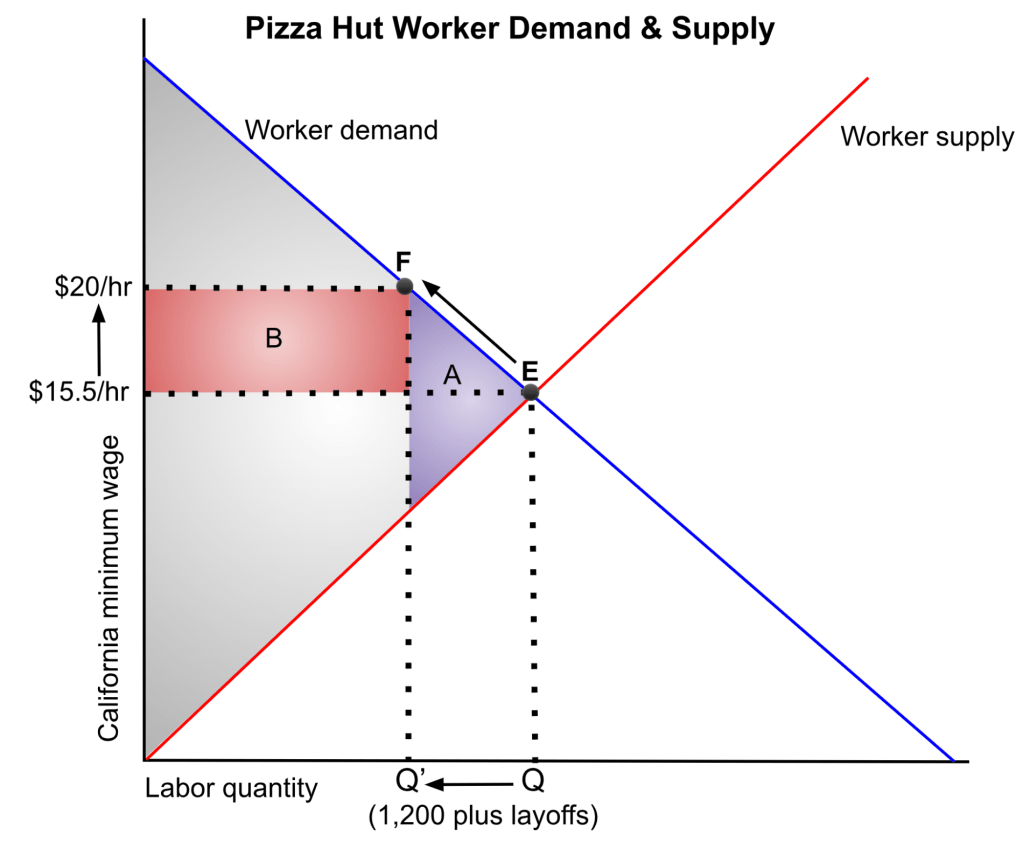
As illustrated in the diagram above, this minimum wage hike distorts the demand and supply of labor by shifting its equilibrium E to point F, thereby reducing the quantity of labor from Q to Q’. The entire grey triangle below the demand curve and above the supply curve represents financial benefits to employers and employees. At the higher wage of $20 per hour, it creates a permanent loss of these benefits for both employer and employees represented in the purple triangle A. Those who remain employed will see gains represented in the red rectangle B, but it comes at the expense of employers.
An irreconcilable dilemma posed by this increase in minimum wage is that working full time at $20 per hour, despite being a large increase from $15.50 per hour, only amounts to $38,000 a year. This figure highlights that individuals will still need a second job or a dual household income just to meet the basic needs in California where the cost of living is one of the highest in the US.
The reality of this wage increase will be more dire than what can be gleaned from the simplistic depiction of demand and supply of labor. Fast-food businesses will not only have to reduce the number of their employees, they will also struggle to operate businesses profitability, potentially leading to store closures, or relocation of businesses to other states, which would reduce tax revenues in California. In this environment, workers in the industry will lose opportunities for new employment, and it may also necessitate many of them to leave the state.
I have been a critic of the free-market economy, proponents of which argues that the pursuit of self-interest produces benefits for all. I tend to disagree with this notion since I believe that a segment of the population will be left behind in competition, and the free market does not provide them with adequate protections. Nevertheless, I also recognize that because of the free market, the US, among other countries, has developed to a level where those who are relatively underprivileged can work in a safer environment, such as in fast-food restaurants, compared to dangerous environments like coal mines. It appears that leaving the forces of the free market to find the Pareto-efficient resource allocation would still be the best approach to optimize the population’s welfare, rather than attempting to achieve it through government intervention.
Continue the conversation with me here.

 The Well Tempered Investor